The robotic arm NOOKLOOK is a tool that is designed to look for small metallic objects in a difficult landscape. The arm has the following structure: it is based on a platform, and all the joints are rigid (can not flex or rotate), but the bars can telescopically retract and extend. The bars can even retract all the way to the opposite direction than the one they are facing without changing the direction of the next bar in the arm. The end of the arm has a small magnet on it that allows to pick up metallic objects. The geometry of the bars is presented on the following picture:
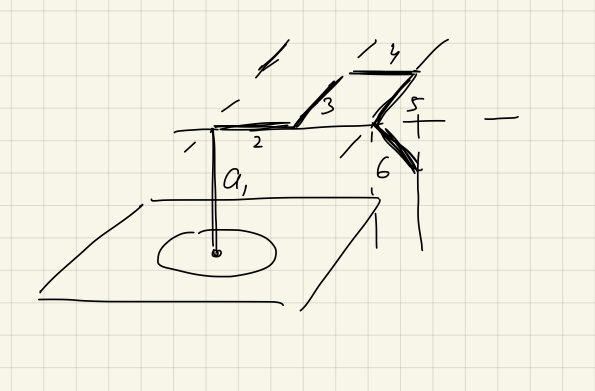
- Consider the transformation that inputs the current lengths of the bars and outputs the position of the end of the arm. Explain why is this transformation linear. Can you provide its matrix
? - Is this transformation injective? Is this transformation surjective? How would you interpret your answers in terms of the robotic arm manipulations?
- You are searching for a coin (of negligible size) that is lying on an incline surface given by the condition
. The robotic arm is very fragile, so you wouldn’t want it to bump into the surface, but you also need to go along the surface in order to be sure that you find the coin. What restrictions would you impose on the lengths of the bars for this search? I am not sure how to remove the inequalities here following the problem statement… - Consider the set of all admissible (for the previous question) lengths of the bars as a subset in the set
of all possible bar lengths. Does it form a subspace? - Assume now that the incline surface is given by
. A corner is formed by this surface and the surface . The ceiling is given by Something about the intersection? We can see high-dimensional subspaces in the parameter space.