The trigonometric form of a complex number
Any complex number 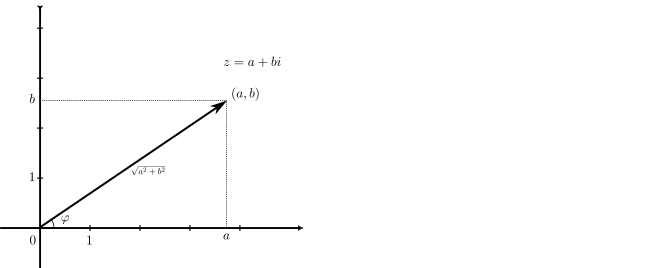
Now consider the polar coordinates
In
and, similarly,
The complex number
The polar coordinates
Let us find some easy trigonometric forms (draw this on paper to see the corresponding transition!):
-
Indeed, as a vector on the plane is degrees counterclockwise from the axis, and of length , so and . -
The absolute value is always a positive number (remember, we are working with non-zero numbers!), and as the vector on the plane is degrees from the origin (so in radians) and of length . -
I will leave the explanation as an exercise: draw the corresponding vector and find its length and the angle with the horizontal axis.
To go from trigonometric form to the usual form
Multiplication in trigonometric form
Given two complex numbers in the standard form
However, this is where the trigonometric form comes into play: let
In other words, when multiplying complex numbers, their absolute values (lengths of the vectors) get multiplied, whereas the arguments add up! This provides us with a geometric description of multiplication of complex numbers. For example, multiplying by
This also provides us with an easier way to think about powers of complex numbers. If
Finding roots of complex numbers
In real numbers, when we introduce roots, they appear as the positive solution of the equation
While we cannot simplify any real roots any further, the situation is different in complex numbers. Let’s take an example and solve the equation
- Let’s start off by taking the right part in trigonometric form:
(why?). - Then we are searching for the two complex numbers
that satisfy:
- The square of their absolute value is
. - Their argument doubled is
.
- Then, automatically, the absolute value of
has to be (as it is a positive real number). At the same time, the argument has two possibilities: and (the second possibility arises from the fact that any angle is defined up to adding ). For any ( ) equation all the different roots will always have the same absolute value but different arguments differing by multiples of . Therefore, the two solutions will be and .
Similarly, the same procedure works for finding roots of higher degrees: let us consider the equation
- Our equation is:
. - The absolute value of
has to be as well as the only positive real number that cubed gives . - The argument has three possible values:
, and as those are the three angles (up to adding ) that, when multiplied by , give you an angle of the form (so, geometrically, fall in the position of the angle ). (This is true as they are of the form for an integer .)
I am deliberately not being too careful with the argument manipulations here for the sake of brevity, and suggest you try some examples or look for this further if this is unclear.