Set equality and element-chasing proofs
This write-up covers one idea and one proof technique, both of which appear repeatedly through the course. The idea: what it means for two sets to be equal. The technique: element-chasing.
1. Set equality
Recall the mental model from lecture: a set is an answering machine. Feed it any object, and it answers yes (
Two sets are equal when they give exactly the same answers to every question.
Idea
means: for every object , .
This is called the principle of extensionality. It says a set is completely determined by its elements. Nothing else — not the order in which you list them, not whether you list them more than once — matters at all:
These are the same set. Order and repetition in the listing are irrelevant; only membership counts.
The principle also tells you what doesn’t count as a proof. Writing
2. Subsets
Definition.
Geometrically, the Venn diagram for
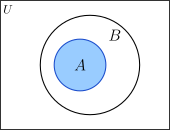
Two important boundary cases: the empty set
Now notice: to say
Idea
.
This reformulation is the key to proving set equalities. Instead of one unwieldy task — checking all objects simultaneously — you have two containment problems, each of which has a clear proof structure.
Why not just check membership directly?
For finite sets given by explicit lists you can, but the sets we work with are usually infinite (e.g.,
) or given by a formula. For these, “checking all objects simultaneously” is meaningless. The and approach is what makes infinite-set proofs possible.
3. The element-chasing template
To prove
Combining the two containments, every proof of
Proof that
:
Let . Argue from the definition of that .
Let . Argue from the definition of that .
The labels
The rough-work heuristic
Before writing a proof, ask: what does
actually mean? Unpack every set-builder expression and every operation ( , , , ) into a statement purely in terms of and logical connectives ( , , , ). Then ask: which logical steps get me from here to where I need to go? That chain of reasoning is your rough work. Only once you have it do you write the clean proof.
4. The four regions
Before working through examples it is worth naming the four regions that appear in every two-set Venn diagram.
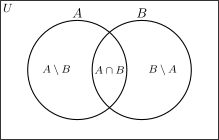
In this diagram:
— the left crescent (in but not ) — the lens (in both) — the right crescent (in but not ) - Everything outside both circles — in neither
Every element of the universe
5. Worked example: the absorption law
Claim. For any sets
Drawing the picture first
The Venn diagram makes this plausible at once:
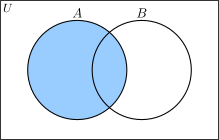
The shaded region is
Rough work
Direction
What does
- Case 1:
. Done — already. - Case 2:
. By definition of intersection, and . In particular . Done.
Direction
What does
Clean write-up
Proof.
Rough work vs. write-up
The rough work and the clean proof contain exactly the same ideas. The write-up drops the exploratory commentary (“what does this mean?”), orders the logical steps cleanly, and removes the self-doubt. The tombstone
signals that both directions are complete. Writing the rough work first is not a shortcut — it is the proof; the write-up is just its final form.
6. A more involved example: distributivity of
Claim. For any sets
This is exactly the distributive law, mirroring
Rough work
Direction
- Case 1:
. Then and , so , and therefore . ✓ - Case 2:
. Then and , so , and therefore . ✓
Direction
- Case 1:
. Then and . Since , we have . So and , giving . ✓ - Case 2:
. Then and , so , and again . ✓
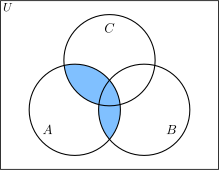
Venn diagram check
The shaded region below is
Clean write-up
Proof.
Connection to logic
The distributive law for sets is the direct translation of the distributive law for logical connectives:
. Every element-chasing proof of a set identity is really a proof of the corresponding logical tautology. This correspondence — sets propositions, , , — is called a Boolean algebra structure, and both and the algebra of propositions are examples of it.
7. What a Venn diagram does — and doesn’t — do
Venn diagrams are an excellent tool. Use them to:
- generate a guess about whether an identity looks plausible,
- plan the case structure of your proof (each region corresponds to a logical case),
- check your answer after completing a proof.
But a diagram is not a proof. It shows one specific configuration of the sets — drawn with circles of particular sizes and positions. A proof must establish the identity for all possible sets: ones that barely overlap, ones where
The element-chasing technique works because it reasons about a generic element
A common confusion
A diagram can suggest a result is false by exhibiting a counterexample: draw
and with no overlap and observe that some candidate identity fails in that picture. That is a valid argument (a counterexample), because a single configuration suffices to disprove a universal claim. What a diagram cannot do is prove a universal claim.